
People are hardwired to worship. We are made to pour our devotion, trust, and longing into something greater than ourselves.
For those who grow up in North Korea, that devotion is forcefully claimed from childhood by the state regime. When June escaped and arrived in South Korea, religion was completely foreign. During her initial orientation at Hanawon Resettlement Center, she was introduced to religion through Catholic services. To June, it felt distant, rigid, and disconnected from her lived reality. She had spent decades surviving extreme hardship; rituals and recitations held little appeal, and she left the experience skeptical and uninterested.
When she arrived at Elim House, a residential community offering physical care and emotional refuge for North Korean women, June was still guarded. Yet it wasn’t an intellectual argument or a rigid lecture that began to soften her defenses.
It was the melody and lyrics of Sunday worship.
When Lyrics Become a Lifeline
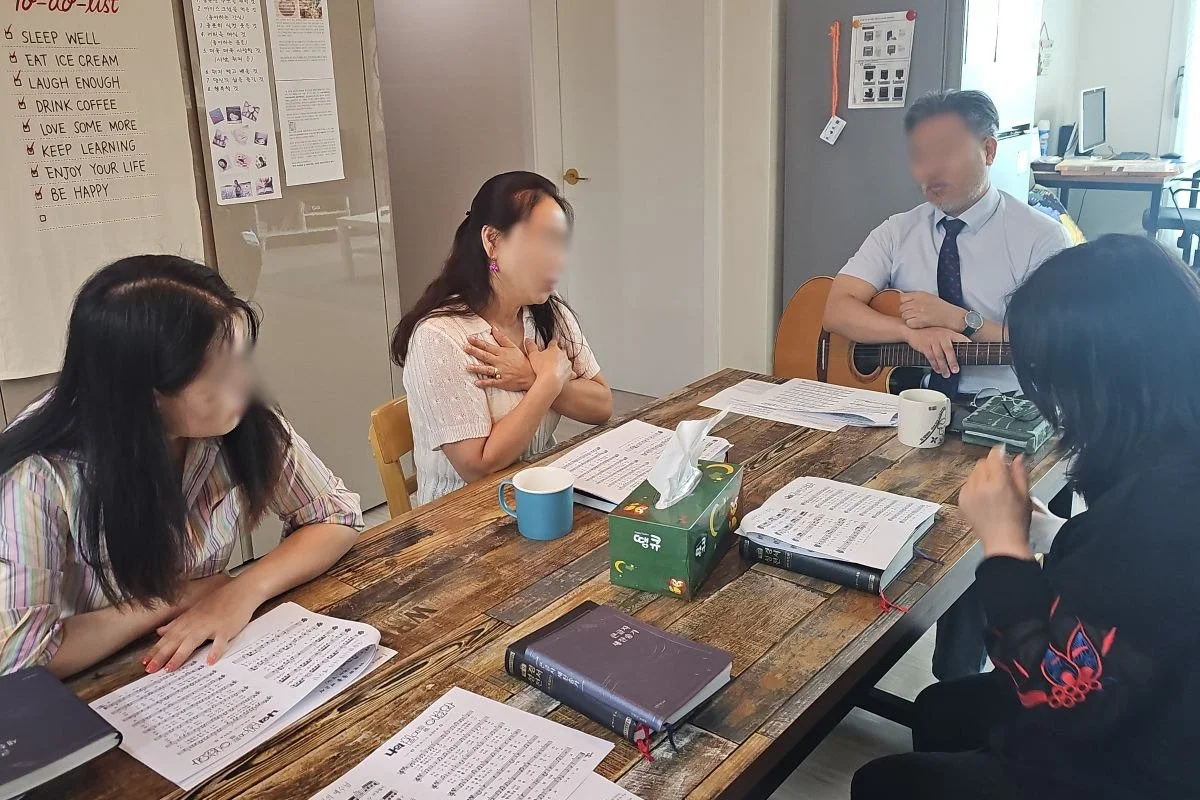
A pastor leads the residents at Elim House in worship during a Sunday Service.
At Elim House, worship is neither mandatory nor performative; it is an open invitation into peace. Soon after arriving, June found herself drawn to the music. Rather than sitting silently, she volunteered to sing a special song during a Sunday service.
She later confided that she chose the song “I Love You, My Jesus” (사랑합니다 나의 예수님) simply because the lyrics spoke to something deep and quiet within her.
From that day forward, Sunday mornings took on a new rhythm. June threw herself into community life: helping coordinate Sunday outfits for fellow residents, thoughtfully selecting music in advance, and assigning vocal harmonies so everyone could participate together. Worship was no longer an abstract concept from a textbook. It was becoming a home.
The Weight of a Mother’s Grief
To understand why these songs resonate so deeply with June, it helps to first see the grief she carries. Beneath her warm smile is the heavy reality shared by so many North Korean refugee mothers.
Before one Sunday service, staff noticed June had been weeping and had barely slept. She had spent the night awake, gripped by a sudden, aching wave of grief for the daughter she had to leave behind in North Korea.
A week later, when staff introduced an upcoming service for incoming and graduating residents, June broke down again. The date coincided with what would have been her son’s birthday. Years earlier, her young son tragically drowned on August 21st. Every year on that anniversary, she had maintained a quiet, solemn tradition of walking to the water’s edge to remember him. But amid the disorienting, fast-paced rush of settling into South Korea, the date had slipped by unnoticed. Realizing she had missed it broke her heart.
Loss has walked alongside June for most of her life. During another service, while preparing to sing “Living Hope” (예수 나의 산 소망), she was overcome with tears mid-song. It happened to be her own birthday. With memories of her late mother and her daughter across the border flooding her mind, she cried out honestly:
"Mom, things are so hard right now. Help me... protect me so I can keep going and live well."
Honest Struggles and the Gift of Real Rest
June’s story is not a fairy tale where every hardship disappears overnight. The reality of building a new life in South Korea is physically and emotionally exhausting.
She often works long and grueling shifts. At times, exhaustion gives way to self-doubt: "How did my life end up like this?" With relational issues, debt and vocational troubles, the uncertainty weighed heavily on her.
Yet, alongside these very real trials, peace has begun to take root:
The Miracles of Simple Peace
Physical Rest: One Saturday, June experienced something unfamiliar: deep rest. Having never been able to nap or sleep past dawn due to hypervigilance, drowsiness suddenly overtook her in the afternoon. She slept, woke, and then fell back asleep at 9:00 PM, resting uninterrupted until 2:00 AM—five unbroken hours of deep mental and physical restoration.
Steadfast Praise: For a recent service, June prepared the song “The Lord Is Here” (주님 여기 계시네). Despite ongoing financial hurdles and housing delays, she stood before her community to sing, tears flowing down her cheeks.
Restoring What We Were Made For
June’s skepticism didn't dissolve because someone debated her; it dissolved because she found a safe space where her pain could be voiced honestly before a God who listens.
We were created to worship—not dictators who demand our submission, not freedom or money, and not the anxiety of our circumstances, but the One who meets broken hearts with lasting hope. Every time June stepped up to sing at Elim House, her voice carried more than a tune. It carried the defiant, beautiful sound of a woman reclaiming her dignity, finding her song, and learning she is deeply loved by a great, good God.