
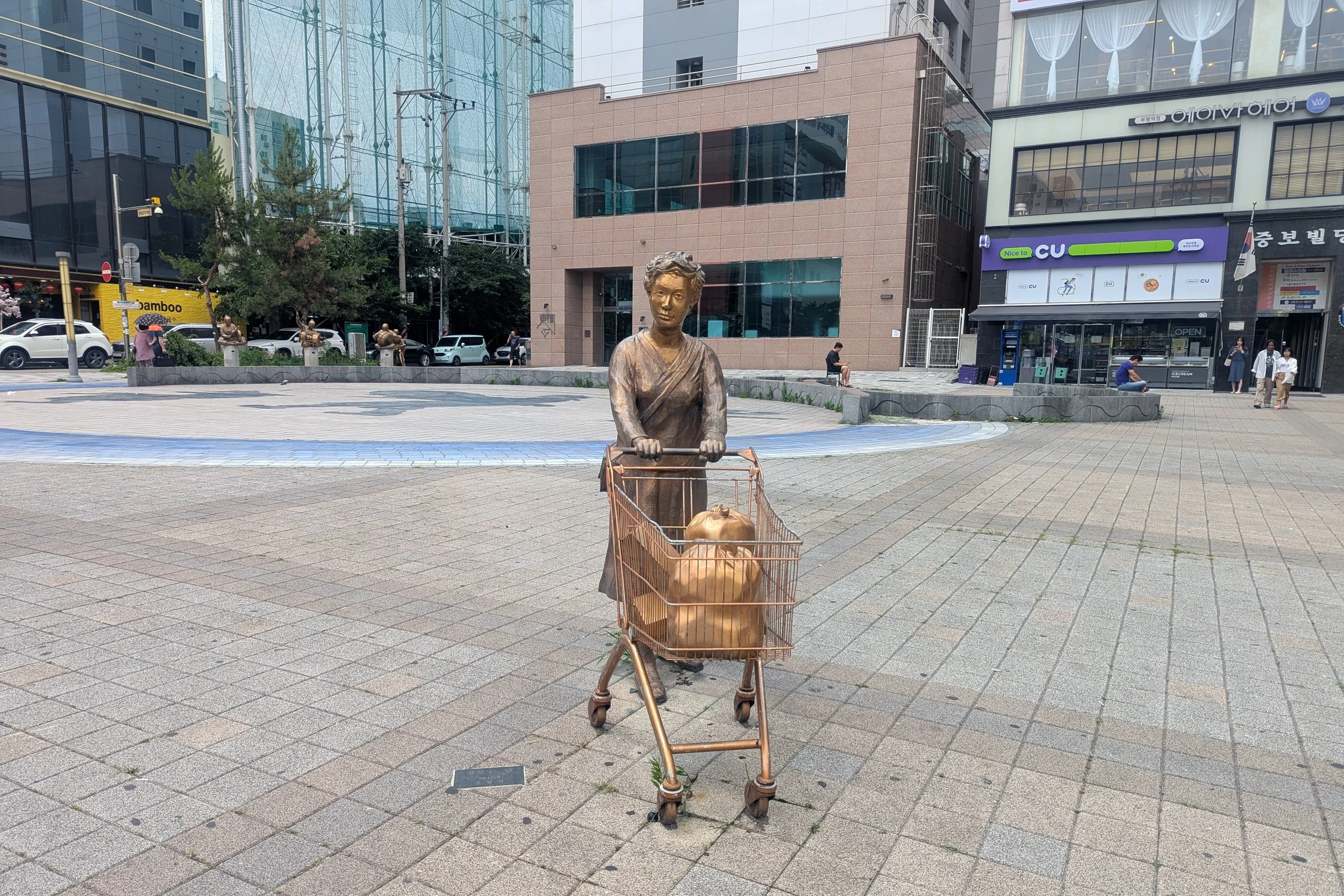
A statue of a mother near a busy subway station in South Korea
As Mother’s Day approaches in many parts of the world, and South Korea prepares to celebrate Parents’ Day on May 8, the month of May is saturated with images of flowers, family gatherings and messages of gratitude. In South Korea, Parents’ Day has been a national holiday since 1973, meant to honor elders and promote filial piety, with children often presenting carnations and gifts to their parents. Yet just across the Demilitarized Zone (DMZ), the definition of "parent" is under constant pressure. For North Korean families, the calendar and the state’s priorities look very different.
The Ideological Parent: When the State Intervenes
In North Korea, the Kim family is officially treated as the only “parent” that truly matters. The state presents the leader as the father of the entire nation, claiming that under socialist ideals he provides for every citizen, leaving no space for ordinary mothers and fathers to be recognized as the primary caregivers in public life. As one analysis explains, this ideological framing helps explain why North Korea never created a Parents’ Day.
Even though both Koreas share the same ancestral heritage, shaped by Confucian traditions that strongly emphasize filial piety and honoring one’s parents, the North has redirected those filial instincts toward the Kim family rather than biological parents.
In 2012, just months into Kim Jong-un’s rule, the regime introduced an official Mother’s Day to be observed on November 16th. This date was chosen to commemorate a 1961 speech by Kim Il-sung on “The duty of mothers in the education of children,” turning what might be a family-centered day into another ritual of loyalty to the revolution and its leaders. State media have praised mothers for raising “revolutionary” children and upholding the socialist state, as well as framing motherhood as a tool of political education rather than primarily a personal family bond. Instead of private celebrations, this day is often marked by mandatory workplace performances and rituals of loyalty to the state.
A Season of Longing and Unseen Sacrifice
This May, as families around the world post public expressions of thanks, a heavy reality unfolds for thousands of North Korean mothers and fathers. Recent reports indicate that more than 14,000 North Korean soldiers are currently fighting for Russia against Ukraine, forming part of a wider foreign contingent on the front lines.
For many North Korean parents, this means sons are sent to a distant, brutal war zone with little to no reliable information reaching home. When a soldier is lost, parents may never receive an honest notification of how or where their child died, leaving them unable to openly mourn. (Read more about two North Korean prisoners of war.) In Pyongyang, the state praises extreme acts of "loyalty," yet for the parents left behind, the loss is deeply personal and quiet.
The Resilience of the Family Bond
The contrast is stark: while much of the world associates this season with family brunches and handwritten cards, countless North Korean parents are enduring separation and loss. Their personal grief is often subordinated to political ambitions, and their roles as protectors of their children are undermined by a state that demands ultimate priority.
However, even in the face of such systemic pressure, the bond between a parent and child remains one of the most resilient forces on earth. At Crossing Borders, we see this firsthand. We see mothers who have risked everything to find safety for their children, and children who carry the hope of their parents into a new life of freedom.
Looking Toward a Future of Reunion
While the current landscape for North Korean families is marked by separation, we believe that no earthly boundary can permanently erase the God-given dignity of the family. We hold onto the hope that our Father of the fatherless sees every hidden tear shed by a mother in the North.
As we celebrate the parents in our lives this month, let us also remember those whose love is currently tested by distance and silence.