
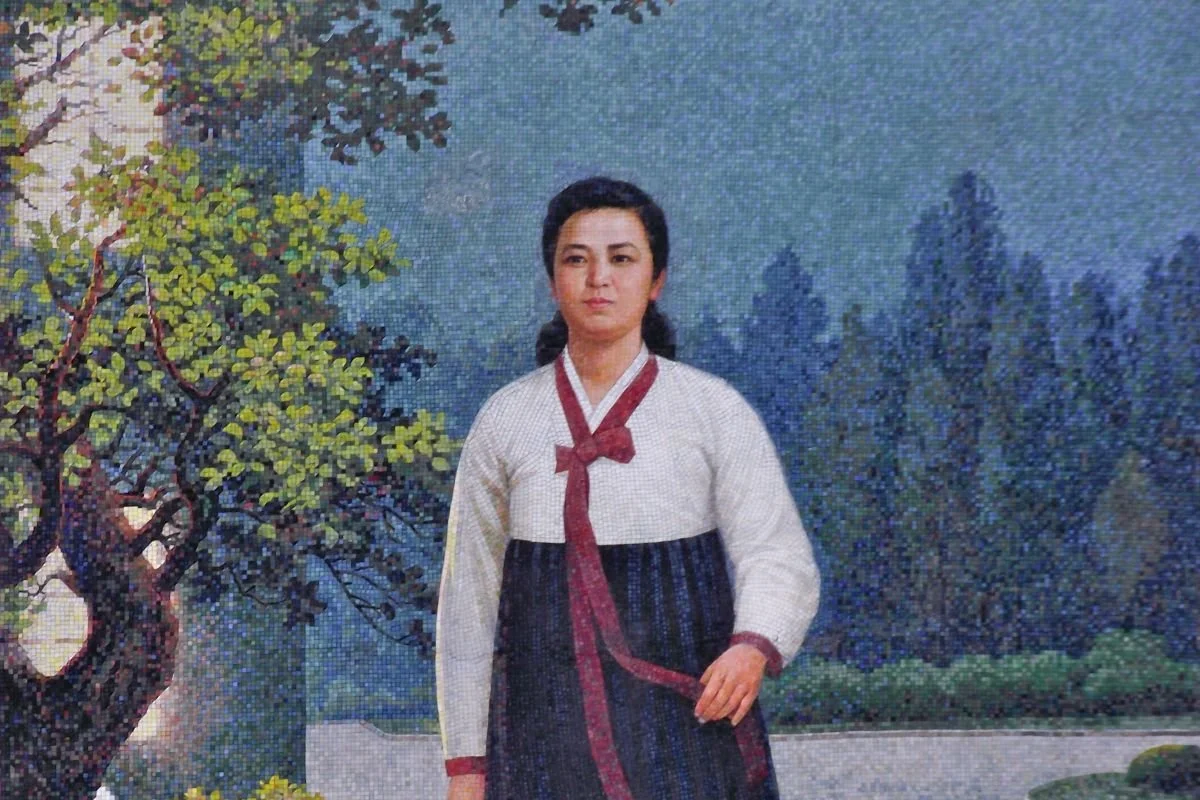
Kim Jong-suk - “Sacred Mother of Revolution”
As the world gathers for Christmas and sings carols on December 24 to celebrate the birth of Jesus, another kind of reverence takes place on the same date in North Korea. Every year on December 24, Pyongyang celebrates the birthday of Kim Jong-suk, the first wife of the regime’s founder, Kim Il-sung, and the mother of Kim Jong-il.
Kim Jong-suk was born in Hoeryong, North Hamgyong province, near the Chinese border in 1917. Interestingly, she came from a Christian background, which is striking given that her image would later be used to underpin one of the world’s most aggressively atheist regimes (read more on Christianity in North Korea). In today’s North Korea, where religion is banned and owning a Bible can lead to imprisonment, her childhood faith is driven underground, while her birthday elevated to near divine status – a day for North Koreans to worship the “Sacred Mother of Revolution,” an anti-Japanese guerrilla and Communist activist.
“ December 24 is framed not as Christmas Eve, but as the birth anniversary of revolutionary heroine Kim Jong-suk”
FROM ORPHANED BELIEVER TO REVOLUTIONARY MOTHER
In official North Korean portraits, Kim Jong-suk is rendered in soft tones: dressed in white hanbok, her face glowing with maternal calm. In North Korean propaganda, she is portrayed as not only a revolutionary, but a moral archetype. Her birthplace is now preserved as a “revolutionary heritage site,” a place of pilgrimage for citizens and soldiers who must pay their respects. However, behind the seemingly perfect image she is remembered for as a key figure in linking the country’s founding myth to the bloodline of Kim Il-sung, Kim Jong-il and Kim Jong-un, she had humble beginnings as a young Christian girl.
Kim Jong-suk’s early life was marked by loss and hardship. Her family fled Japanese-ruled Korea for Yanji in northeast China around 1922, scraping by as tenant farmers. When she was still a teenager, both her parents and all her siblings died, leaving her effectively an orphan. This period coincided with an era in which Northern Korea and nearby Manchuria were home to vibrant Christian communities, leading her to establish ties with local churches and placing the young Kim Jong-suk squarely inside a milieu of Bible teaching and prayer even as colonial repression intensified (read more on North Korea as the Christian Hub of the East).
By the mid-1930s, Kim Jong-suk was attached to anti-Japanese rebel units in Manchuria, at first doing support work including cooking, mending uniforms and caring for children, before becoming more directly involved in Kim Il-sung’s partisan network. Meanwhile, in North Korean legend, she famously saved Kim Il-sung’s life during a firefight and is portrayed as both his loyal comrade and selfless caretaker, a narrative that later propaganda would elevate into a hagiography. When many Koreans moved into Soviet territory around 1940, Kim Jong-suk followed Kim Il-sung to the Soviet Far East, where they married and lived on a Red Army base near Khabarovsk. There, she gave birth to their first son, North Korea’s future leader, Kim Jong-il, in early 1941 and later a second son, Kim Pyong-il (often known as Kim Man-il).
With Japan’s defeat, the young family returned to Korea in 1945. As Kim Il-sung consolidated power in the Soviet-occupied North, Kim Jong-suk became de facto first lady of the emerging state. She hosted Soviet officials, appeared at public events and took a special interest in war orphans, helping found what became the Mangyongdae Revolutionary School for children of fallen fighters, a role presented domestically as proof of her maternal virtue toward the nation’s next generation. Her life ended abruptly in 1949, when she died at age 32 due to complications from an ectopic pregnancy.
CHRISTMAS ERASED
As North Korea hardened into a totalitarian state, open Christianity was not only discouraged but criminalized, and the calendar itself was re-engineered to marginalize Christian observances. Christmas celebrations were banned, underground churches persecuted and December turned into a season of intensified political study sessions.
In this context, December 24 is framed not as Christmas Eve, but as the birth anniversary of a revolutionary heroine, making Kim Jong-suk’s commemoration the official focus of the day. Some historians even note a profound irony: Kim Jong-suk’s Christian upbringing immersed her in ideals of purity and devotion, virtues the regime later repurposed to sanctify its revolutionary ethos. In this stark substitution, her birthday eclipses one sacred nativity with another, from the Virgin Mary giving birth to the promised king Jesus, to Kim Jong-suk delivering Kim Jong-il to secure the Kim dynasty’s royal bloodline.