
Christmas in North Korea

One Person, One Soul

As we closed out 2025, our South Korea staff hosted a Christmas party—a time to celebrate God’s faithfulness. We invited North Korean refugees in our community to join us for an evening of celebration, rest and fellowship.

Students from our line dancing and English classes performed routines and short speeches, showcasing what they had learned throughout the year. Games and laughter filled the room, and for many, it was a rare opportunity to relax and feel fully at ease. Our prayer throughout the evening was simple: that each person who attended would know they were welcomed, valued, and deeply loved.

Our prayer throughout the evening was simple: that each person who attended would know they were welcomed, valued, and deeply loved.

One small moment in particular captured the very heart of Crossing Borders’ mission.
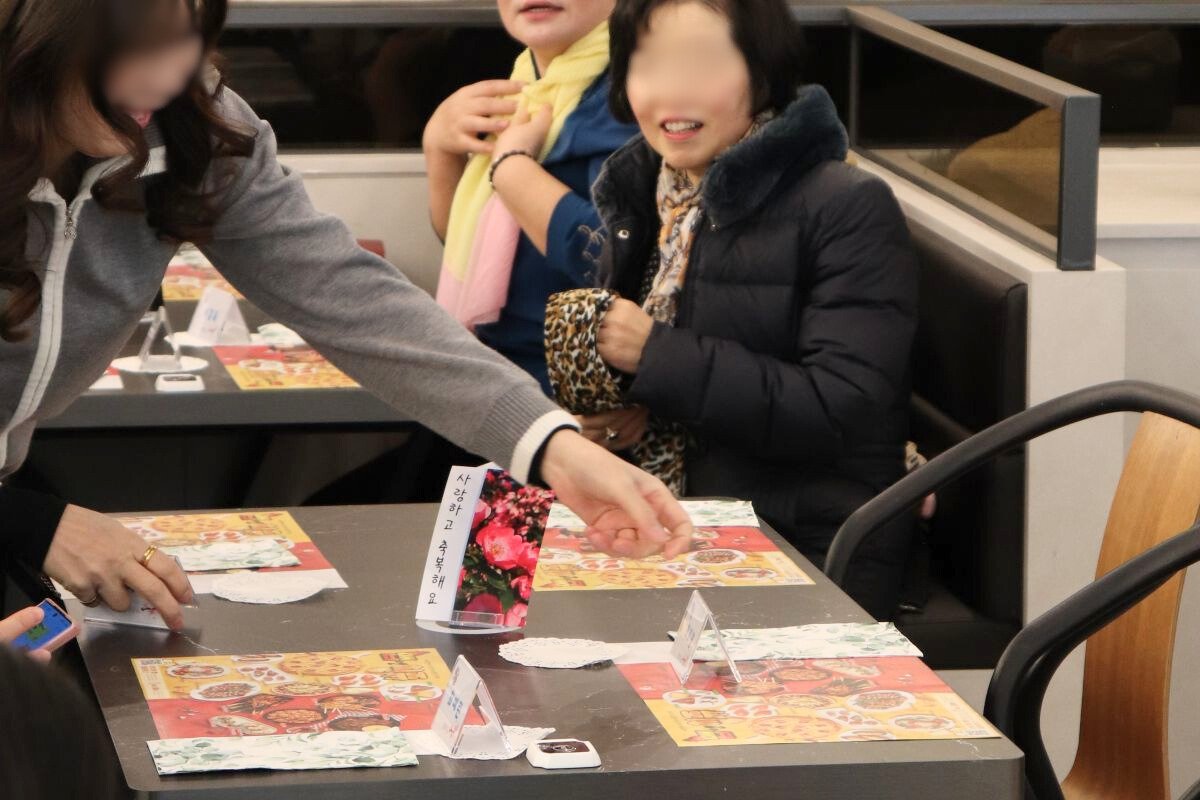
Before the celebration, we gathered at a restaurant where we had reserved a room for our refugee community members. Our Team Lead, Cindy, prepared personalized place settings for each guest, complete with handwritten name placards. On the morning of the event, one woman contacted Cindy to say she wanted to attend our party. Though it meant extra effort at the last minute, Cindy felt it was important that her name placard be there too.

That simple decision fostered one of the most meaningful moments of the entire evening.

When the woman arrived and saw her name written on the placard, she stopped and picked it up with gratefulness. She shared with our staff that for weeks she had been working a new job where she was treated harshly and overwhelmed with responsibility. Exhausted, discouraged, and feeling invisible, she came to the party worn down. Seeing her name—prepared intentionally for her—restored a sense of dignity and worth that she had not felt in a long time. She asked if she could take the placard home.

A few days later, our staff hand-delivered small gifts we had prepared for each attendee but had forgotten to distribute during the event. Of all the people we visited, this woman was the only one who invited our staff inside of her home for some tea. During that visit, she opened up about her life and her struggles. We thank God for these intimate encounters and pray that our connection with her will continue to grow, including inviting her to our retreat this fall.

Her response regarding our party was echoed by many others. Several attendees shared that they had never been to an event where they felt so personally cared for and seen. When asked what distinguished this gathering from other organizations or government-sponsored events refugees often attend, Cindy’s answer was clear: intentional, individual care for each soul. We did not rush the schedule or push an agenda. We created space for people to shine. We noticed names, details, and needs. Through small acts of love, we communicated something profound: you matter.

The Psalmist says of God in 56:8, “You have kept count of my tossings; put my tears in your bottle.”

This verse captures the heart of Crossing Borders’ work. Through your faithful partnership, we are able to reflect the love of Christ to North Korean refugees who have endured deep loss and trauma. By caring for each individual soul, we point people to the God who knows every restless night and every tear that has been shed—the Shepherd who calls His sheep by name.

Thank you for standing with us in this mission. Your support makes moments like these possible and allows the gospel to be lived out, one person at a time.
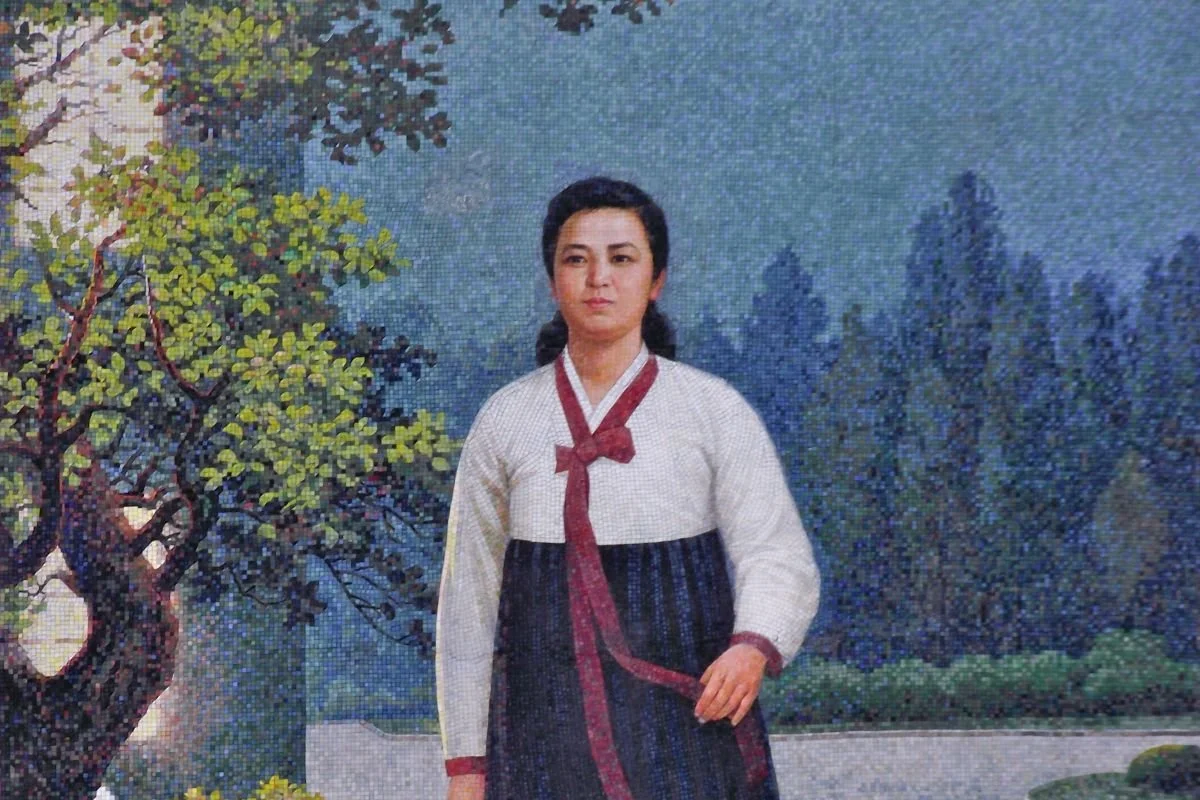
Kim Jong-suk: The Woman Who Replaced Christmas in North Korea

Kim Jong-suk - “Sacred Mother of Revolution”

As the world gathers for Christmas and sings carols on December 24 to celebrate the birth of Jesus, another kind of reverence takes place on the same date in North Korea. Every year on December 24, Pyongyang celebrates the birthday of Kim Jong-suk, the first wife of the regime’s founder, Kim Il-sung, and the mother of Kim Jong-il.

Kim Jong-suk was born in Hoeryong, North Hamgyong province, near the Chinese border in 1917. Interestingly, she came from a Christian background, which is striking given that her image would later be used to underpin one of the world’s most aggressively atheist regimes (read more on Christianity in North Korea). In today’s North Korea, where religion is banned and owning a Bible can lead to imprisonment, her childhood faith is driven underground, while her birthday elevated to near divine status – a day for North Koreans to worship the “Sacred Mother of Revolution,” an anti-Japanese guerrilla and Communist activist.

December 24 is framed not as Christmas Eve, but as the birth anniversary of revolutionary heroine Kim Jong-suk

FROM ORPHANED BELIEVER TO REVOLUTIONARY MOTHER

In official North Korean portraits, Kim Jong-suk is rendered in soft tones: dressed in white hanbok, her face glowing with maternal calm. In North Korean propaganda, she is portrayed as not only a revolutionary, but a moral archetype. Her birthplace is now preserved as a “revolutionary heritage site,” a place of pilgrimage for citizens and soldiers who must pay their respects. However, behind the seemingly perfect image she is remembered for as a key figure in linking the country’s founding myth to the bloodline of Kim Il-sung, Kim Jong-il and Kim Jong-un, she had humble beginnings as a young Christian girl.

Kim Jong-suk’s early life was marked by loss and hardship. Her family fled Japanese-ruled Korea for Yanji in northeast China around 1922, scraping by as tenant farmers. When she was still a teenager, both her parents and all her siblings died, leaving her effectively an orphan. This period coincided with an era in which Northern Korea and nearby Manchuria were home to vibrant Christian communities, leading her to establish ties with local churches and placing the young Kim Jong-suk squarely inside a milieu of Bible teaching and prayer even as colonial repression intensified (read more on North Korea as the Christian Hub of the East).

By the mid-1930s, Kim Jong-suk was attached to anti-Japanese rebel units in Manchuria, at first doing support work including cooking, mending uniforms and caring for children, before becoming more directly involved in Kim Il-sung’s partisan network. Meanwhile, in North Korean legend, she famously saved Kim Il-sung’s life during a firefight and is portrayed as both his loyal comrade and selfless caretaker, a narrative that later propaganda would elevate into a hagiography. When many Koreans moved into Soviet territory around 1940, Kim Jong-suk followed Kim Il-sung to the Soviet Far East, where they married and lived on a Red Army base near Khabarovsk. There, she gave birth to their first son, North Korea’s future leader, Kim Jong-il, in early 1941 and later a second son, Kim Pyong-il (often known as Kim Man-il).

With Japan’s defeat, the young family returned to Korea in 1945. As Kim Il-sung consolidated power in the Soviet-occupied North, Kim Jong-suk became de facto first lady of the emerging state. She hosted Soviet officials, appeared at public events and took a special interest in war orphans, helping found what became the Mangyongdae Revolutionary School for children of fallen fighters, a role presented domestically as proof of her maternal virtue toward the nation’s next generation. Her life ended abruptly in 1949, when she died at age 32 due to complications from an ectopic pregnancy.

CHRISTMAS ERASED

As North Korea hardened into a totalitarian state, open Christianity was not only discouraged but criminalized, and the calendar itself was re-engineered to marginalize Christian observances. Christmas celebrations were banned, underground churches persecuted and December turned into a season of intensified political study sessions. 

In this context, December 24 is framed not as Christmas Eve, but as the birth anniversary of a revolutionary heroine, making Kim Jong-suk’s commemoration the official focus of the day. Some historians even note a profound irony: Kim Jong-suk’s Christian upbringing immersed her in ideals of purity and devotion, virtues the regime later repurposed to sanctify its revolutionary ethos. In this stark substitution, her birthday eclipses one sacred nativity with another, from the Virgin Mary giving birth to the promised king Jesus, to Kim Jong-suk delivering Kim Jong-il to secure the Kim dynasty’s royal bloodline.

North Korea’s Actual ‘War on Christmas’

Christmas has become a bonanza of commercialization in the west. In the blizzard of sleigh bells and elves on shelves, it’s easy to forget the true reason for the season. We get caught up in the presents and the Christmas parties and it seems like the baby in the manger, the angels and the shepherds get forgotten. 

Thankfully there are brief moments when Christmas carols like “Hark the Herald Angels Sing” hit the airwaves or we catch a glimpse of  a nativity scene in our neighbor’s yard that serve as good, albeit fleeting reminders. Even in a secularized country like the U.S., it’s hard to remember that Christmas is about God’s amazing and miraculous gift to us in Christ. Not so in North Korea where the holiday is almost completely eradicated.

For most North Koreans, Christmas is another winter day. Of course, there are celebrations in the state-controlled churches (which exist mainly for the benefit of sightseeing foreigners). Most North Koreans are completely unaware of the holiday. The North Korean government has a stranglehold on information and the regime is  particularly hostile to any form of religion.

For North Koreans, Kim Jong-un and his family function as gods. Other religious figures or beliefs are strictly forbidden, as they might interfere with the undying loyalty of citizens to the Kim family. In fact, in 2016, Kim Jong-un mandated that the nation celebrate his grandmother’s birthday on December 24, to further suppress any attempts of celebrating anything else. All citizens were required to pay tribute to the deceased royal grandmother while much of the world was celebrating Christmas Eve.

In the U.S. and other countries, the “war on Christmas” is a figurative controversy. In North Korea, it is literal. At one point, South Korea erected a sixty-foot-tall Christmas tree near the border with the north and lit it up at Christmas. Its purpose was to show solidarity with North Koreans who still wished to celebrate the holiday. The North Korean government threatened to shoot it down, claiming the Christmas tree constituted “psychological warfare.”

Since the threat of punitive action from the regime is ever present, Christians in North Korea who do seek to celebrate Christmas have to do so in secret. A family may meet for quiet prayer inside their house or on rare occasions it may be “possible for Christians to go unobtrusively into the mountains and to hold a 'service' at a secret location. Then there might be as many as 60 or 70 North Koreans gathered together.”  

For a part of the world once known as the “Jerusalem of the East”, this is a dark reality for the North Korea of today. In an interview with author and blogger Tim Challies, Joel Kim, President of Westminster Seminary California, shared that “Pyongyang was the site of a number of Christian schools, including the first Presbyterian seminary in Korea [in 1901].” This seminary would go on to become ground zero for much evangelical activity in Korea. It is shocking and disheartening to see how far North Korea has fallen in the span of a century.

Even where celebration of Christmas is possible, it will be subdued and secretive. There are no festivities—Christmas in North Korea will certainly not have eggnog, Santa Claus, carols or even presents. In 2017, Kim Jong-un actually prohibited “gatherings that involve alcohol and singing.

Such festivity would imply that there is something other than the North Korean government and leaders that is worth celebrating. It would communicate that someone other than the Kim dynasty is able to give good things to its people. The Kim regime has worked hard to make citizens dependent on their government, to look to the Kim family alone for leadership and all good things. In countries around the world this December, Christians will celebrate God’s miraculous gift of salvation and hope to the world in the person of Jesus Christ. But for the North Korean government, this gift constitutes a threat to their supremacy and exclusive control over its people. For many North Koreans this year, it will be an act of courage to celebrate Christmas at all.

As we open our gifts and gather with our family and friends, let us remember the wonderful gift we have as we celebrate Christ in freedom this year. Let us also remember those who risk their lives to celebrate in secret.