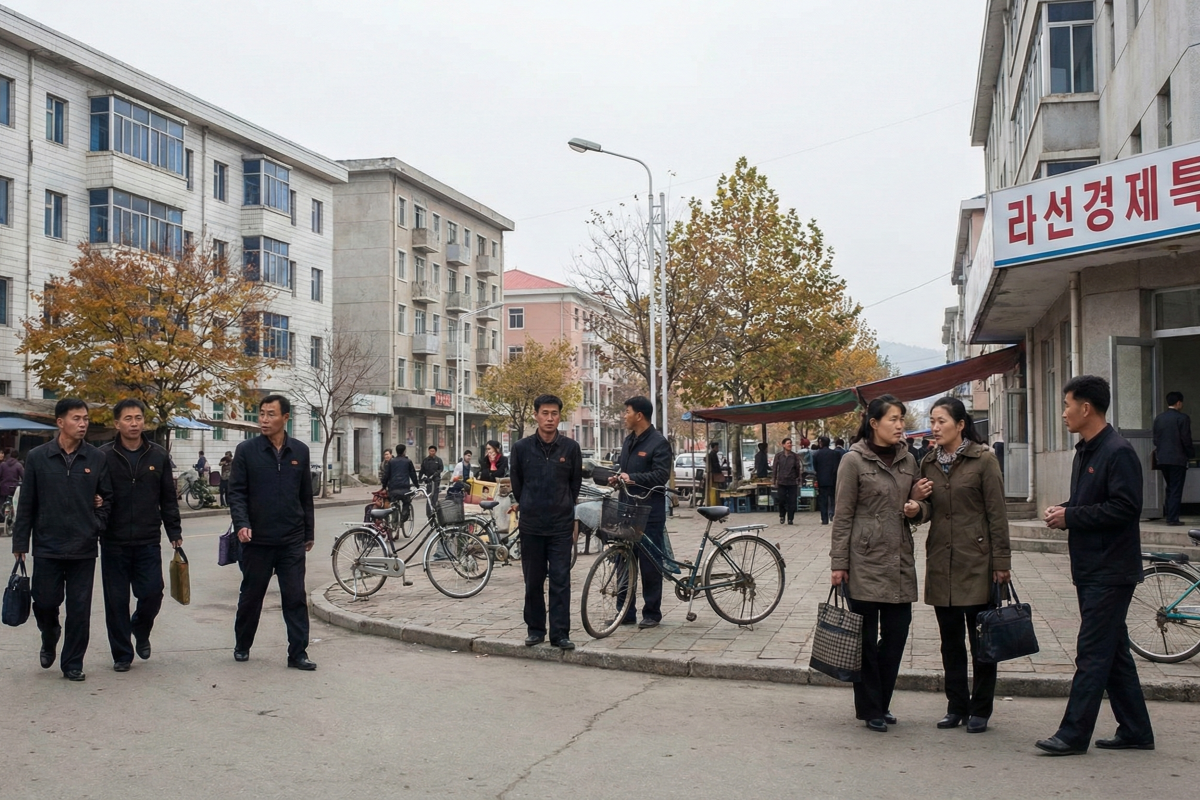
Despite North Korea maintaining its most restrictive border controls in decades, a steady flow of online content is complicating assumptions about its total isolation. Recent videos on China’s Douyin (TikTok) platform show Chinese merchants casually entering North Korea’s Rason Special Economic Zone, checking into hotels, browsing markets and trading in scenes that appear at odds with the image of a sealed-off DPRK. These appearances coincide with reports that a limited number of Chinese businessmen have been granted entry to the zone through invitations from local North Korean firms. Interestingly, they surfaced after a short-lived reopening of Rason to foreign tourists in early 2025, which was halted a few weeks later, with media outlets speculating that the sudden closure was a reaction to tourists’ candid online posts that Pyongyang could not fully control. As a result, Rason has re-emerged as an unexpected window into life inside the secretive country, revealing livelihoods far more ordinary than the famine and isolation narratives that dominate western coverage.
DOUYIN’S RASON: WHY ARE WE SO FREE IN NORTH KOREA?
Footages circulating on Douyin this year depict a version of North Korean that contrasts sharply with much western reporting. These clips show Chinese merchants entering Rason with relative ease and moving through public spaces in ways that suggest a functioning local economy rather than a shuttered border city. Given the videos are informal and seemingly unscripted, with handled shots, casual commentary and spontaneous interactions, they create a powerful counter-narrative to the hermit kingdom’s dominant portrayal as destitute.
Meanwhile, reactions from Chinese viewers reveal a starkly different interpretation of North Korea from the one familiar in the west. Some commenters compared Rason to Shenzhen or Shanghai, celebrating what they perceive as an emerging commercial hub on China’s doorstep. In a number of footages, restaurant menus can be seen displaying both Korean and Chinese, which offers a small but telling detail of the cross-border commercial integration already under way.
In a video titled “Why are we so free in North Korea,” a Chinese businessman, Mr. Wang, who manufactures false eyelashes in Rason speaks directly into the camera, praising the city for its “good air quality and nice scenery,” and insisting that “if you are here for business then there are little restrictions.” He adds that “if you have some contributions to North Korea, then you will feel very free here, you can go anywhere, eat anywhere, drink anywhere, live in any hotel. There is no one monitoring or following me. It is so convenient – there is not much difference between here and China. It feels even safer in North Korea than in China as North Koreans are especially friendly to Chinese people”. Urging viewers “not to listen to nonsense [about North Korea lacking freedom] on the internet,” he claims anyone visiting will “feel the simplistic atmosphere in North Korea.”
Wang also encourages others to consider trading with North Korea, citing far lower labor costs, strong craftsmanship and a ready supply of workers, “easily get a few ten thousand skillful workers around 30 years old,” he says. This gives a vivid example of the kind of small-scale manufacturing investment driving part of the Chinese presence in Rason. Another Chinese businessman in the hair-products industry has likewise posted videos documenting his regular trade trips into Rason since February 2025, noting that his goods move in and out of North Korean on a weekly basis and that urgent orders can be dispatched at any time without delay (read more about Chinese wigs and false lashes made in North Korea).
AN OUTSIDER’S LENS: WHAT WESTERN VISITORS SEE
As one of the first westerners to enter North Korea since the pandemic, British travel vlogger, Mike O’Kennedy, documented his guided trip to Rason earlier this year. O’Kennedy captured both genuine snapshots of daily life and the unmistakable mechanisms of state supervision. In subsequent interviews, the YouTuber recounted moments of surprisingly normalcy, from sharing North Korean beer with guides and singing karaoke to browsing local markets and engaging in casual conversations that felt far removed from the country’s intimidating reputation. At times, the comforts even resembled any provisional city stay in the west. Yet his footage also documented the rigid controls underlying the experience. A children’s performance he attended, which was complete with futuristic costuming and rocket-theme backdrops, underscored the omnipresence of political messaging. While O’Kennedy noted that he never felt directly endangered, he described a persistent sense of “paranoia and anxiety.”
Ultimately, it should be remembered that Rason functions as a place where foreign visitors can observe fragments of ordinary life but never beyond state-approved boundaries. It operates as a controlled interface with a mix of economic hub and exposure-management zone designed to show just enough of North Korea to serve the regime’s interests. Rason's portrayed vitality is not a sign of national liberation, but a calculated, temporary opening that masks the enduring nature of an oppressive, surveillance-heavy state.