North Korean Workers

Moving Freely in Rason, North Korea’s Hub of Trade and Business

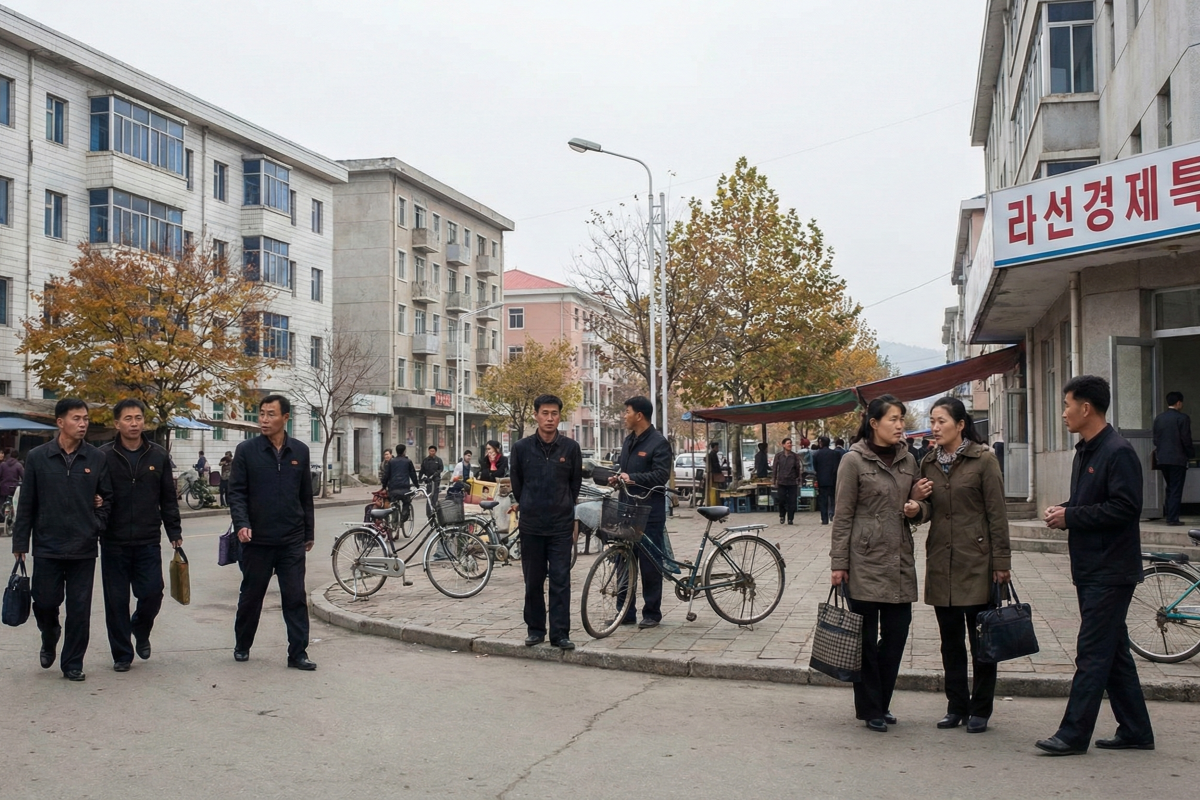
Despite North Korea maintaining its most restrictive border controls in decades, a steady flow of online content is complicating assumptions about its total isolation. Recent videos on China’s Douyin (TikTok) platform show Chinese merchants casually entering North Korea’s Rason Special Economic Zone, checking into hotels, browsing markets and trading in scenes that appear at odds with the image of a sealed-off DPRK. These appearances coincide with reports that a limited number of Chinese businessmen have been granted entry to the zone through invitations from local North Korean firms. Interestingly, they surfaced after a short-lived reopening of Rason to foreign tourists in early 2025, which was halted a few weeks later, with media outlets speculating that the sudden closure was a reaction to tourists’ candid online posts that Pyongyang could not fully control. As a result, Rason has re-emerged as an unexpected window into life inside the secretive country, revealing livelihoods far more ordinary than the famine and isolation narratives that dominate western coverage.

DOUYIN’S RASON: WHY ARE WE SO FREE IN NORTH KOREA?

Footages circulating on Douyin this year depict a version of North Korean that contrasts sharply with much western reporting. These clips show Chinese merchants entering Rason with relative ease and moving through public spaces in ways that suggest a functioning local economy rather than a shuttered border city. Given the videos are informal and seemingly unscripted, with handled shots, casual commentary and spontaneous interactions, they create a powerful counter-narrative to the hermit kingdom’s dominant portrayal as destitute.

Meanwhile, reactions from Chinese viewers reveal a starkly different interpretation of North Korea from the one familiar in the west. Some commenters compared Rason to Shenzhen or Shanghai, celebrating what they perceive as an emerging commercial hub on China’s doorstep. In a number of footages, restaurant menus can be seen displaying both Korean and Chinese, which offers a small but telling detail of the cross-border commercial integration already under way.

In a video titled “Why are we so free in North Korea,” a Chinese businessman, Mr. Wang, who manufactures false eyelashes in Rason speaks directly into the camera, praising the city for its “good air quality and nice scenery,” and insisting that “if you are here for business then there are little restrictions.” He adds that “if you have some contributions to North Korea, then you will feel very free here, you can go anywhere, eat anywhere, drink anywhere, live in any hotel. There is no one monitoring or following me. It is so convenient – there is not much difference between here and China. It feels even safer in North Korea than in China as North Koreans are especially friendly to Chinese people”. Urging viewers “not to listen to nonsense [about North Korea lacking freedom] on the internet,” he claims anyone visiting will “feel the simplistic atmosphere in North Korea.” 

Wang also encourages others to consider trading with North Korea, citing far lower labor costs, strong craftsmanship and a ready supply of workers, “easily get a few ten thousand skillful workers around 30 years old,” he says. This gives a vivid example of the kind of small-scale manufacturing investment driving part of the Chinese presence in Rason. Another Chinese businessman in the hair-products industry has likewise posted videos documenting his regular trade trips into Rason since February 2025, noting that his goods move in and out of North Korean on a weekly basis and that urgent orders can be dispatched at any time without delay (read more about Chinese wigs and false lashes made in North Korea).

AN OUTSIDER’S LENS: WHAT WESTERN VISITORS SEE

As one of the first westerners to enter North Korea since the pandemic, British travel vlogger, Mike O’Kennedy, documented his guided trip to Rason earlier this year. O’Kennedy captured both genuine snapshots of daily life and the unmistakable mechanisms of state supervision. In subsequent interviews, the YouTuber recounted moments of surprisingly normalcy, from sharing North Korean beer with guides and singing karaoke to browsing local markets and engaging in casual conversations that felt far removed from the country’s intimidating reputation. At times, the comforts even resembled any provisional city stay in the west. Yet his footage also documented the rigid controls underlying the experience. A children’s performance he attended, which was complete with futuristic costuming and rocket-theme backdrops, underscored the omnipresence of political messaging. While O’Kennedy noted that he never felt directly endangered, he described a persistent sense of “paranoia and anxiety.”

Ultimately, it should be remembered that Rason functions as a place where foreign visitors can observe fragments of ordinary life but never beyond state-approved boundaries. It operates as a controlled interface with a mix of economic hub and exposure-management zone designed to show just enough of North Korea to serve the regime’s interests. Rason's portrayed vitality is not a sign of national liberation, but a calculated, temporary opening that masks the enduring nature of an oppressive, surveillance-heavy state.

Top North Korean Headlines - April 2022

NORTH KOREAN WORKERS DISAPPEAR FROM SHANGHAI DORM

  • North Korea has requested help from China to track down 20 North Korean women working for a clothing company in Shanghai and their manager who they suspect are now on the run as refugees.  

  • Beijing is under two bilateral border and immigration pacts with Pyongyang to return North Koreans found to be illegally within Chinese territory.

  • The group of textile workers were dispatched from North Korea to earn foreign currency in China for the government and were supposed to be in quarantine when they disappeared from their dormitory in mid-February.

  • A source told Radio Free Asia that the company owner had immediately reported the disappearance to the North Korean consulate in Beijing, which had in turn sought assistance from the Chinese police to track the escapees and monitor railway stations heading towards the border. The source further commented that “[the] workers and the manager have not been found for a month since they went missing...[the] North Korean consulate is under a state of emergency to find if they have already escaped and are in Southeast Asia or already entered South Korea.”

  • Another source from Dandong, a Chinese city bordering North Korea, said that Shanghai is so large with a population of around 26 million people that “it would be easy to hide there...[but] if they were to leave by train or bus, they would need to show ID to buy a ticket. It therefore seems this is a planned escape led by a guide, since the manager and the workers have not been caught.”

  • According to the U.S. State Department’s 2021 Trafficking in Persons Report, there are an estimated 20,000 to 80,000 North Koreans working in China. Meanwhile, escapes by North Koreans working in China are rare because Pyongyang only sends its most loyal citizens abroad, monitors them closely, and punishes their family members.

  • Although United Nations nuclear sanctions froze the issuance of work visas and mandated the repatriation of North Korean nationals working abroad by the end of 2019, China and Russia often bypass these sanctions by granting workers short-term student or visitor visas so they can legally work in other countries.

Source:
https://www.rfa.org/english/news/korea/china-03222022201416.html
https://www.visiontimes.com/2022/03/23/north-korean-women-rented-to-china-for-work-disappear-from-shanghai-dorm-presumed-defected-report.html

NORTH KOREAN LEADER’S SISTER WARNS OF NUCLEAR RETALIATION

  • In response to South Korean Defense Minister Suh Wook’s remarks on the South’s ability to strike the North’s missile launch points, North Korean leader Kim Jong-un's sister, Kim Yo-jong, issued two statements in state media calling Suh “a scum-like guy” and claiming that “[in] case South Korea opts for military confrontation with us, our nuclear combat force will have to inevitably carry out its duty.”

  • Kim Yo-jong also dismissed Suh’s assertions in relation to the South’s militia abilities, which North Korean analyst, Cheong Seong-chang, noted was an attempt to “enhance the internal unity within the North” amidst uncertainty and concerns about relations with the new South Korean cabinet.

  • Kim Yo-jong further added that North Korea did not want a war and would only respond using nuclear weapons if attacked. 

  • According to Sydney Seiler, national intelligence officer for North Korea at the National Intelligence Council, North Korea uses US-South Korea joint military drills as a pretext for its provocations and is employing a “short-term choreography” or propaganda which Pyongyang has historically utilized while seeking to convince others that the escalation of tension is simply a result of the US-South Korean alliance and not the desired outcome of its actions.

  • Seiler also noted that North Korea has breached numerous denuclearisation agreements in the past, “each breakout that we have seen, agreed framework breakout, six-party talks, breakout, leap day agreement, breakout, Singapore-Hanoi breakout, each time the [North Korean weapons] program advances a little more, making it harder to imagine denuclearisation as a viable topic for discussion.”

Source:
http://www.koreaherald.com/view.php?ud=20220408000121
https://www.bbc.com/news/world-asia-60992313

NORTH KOREA DEMOLISHES SOUTH KOREAN-OWNED $75 MILLION GOLF RESORT

  • In 2019, Kim Jong-un called the dozens of South Korean-built facilities at North Korea’s Diamond Mountain resort “shabby” and lacked “national character”, and ordered the removal of “all the unpleasant-looking facilities of the south [Korean] side” after Seoul refused to defy US-led sanctions that kept tourism from resuming.

  • South Korea’s Unification Ministry and other parties requested to negotiate with the North following Kim’s announcement, but their requests were denied.

  • The North postponed the demolition work in 2020 during the Covid-19 pandemic until days before the South Korean presidential election in March 2022. South Korea’s Unification Ministry called for North Korea to stop the “unilateral” destruction of the Haegumgang Hotel, which serves as one of the last symbols of inter-Korean engagement.

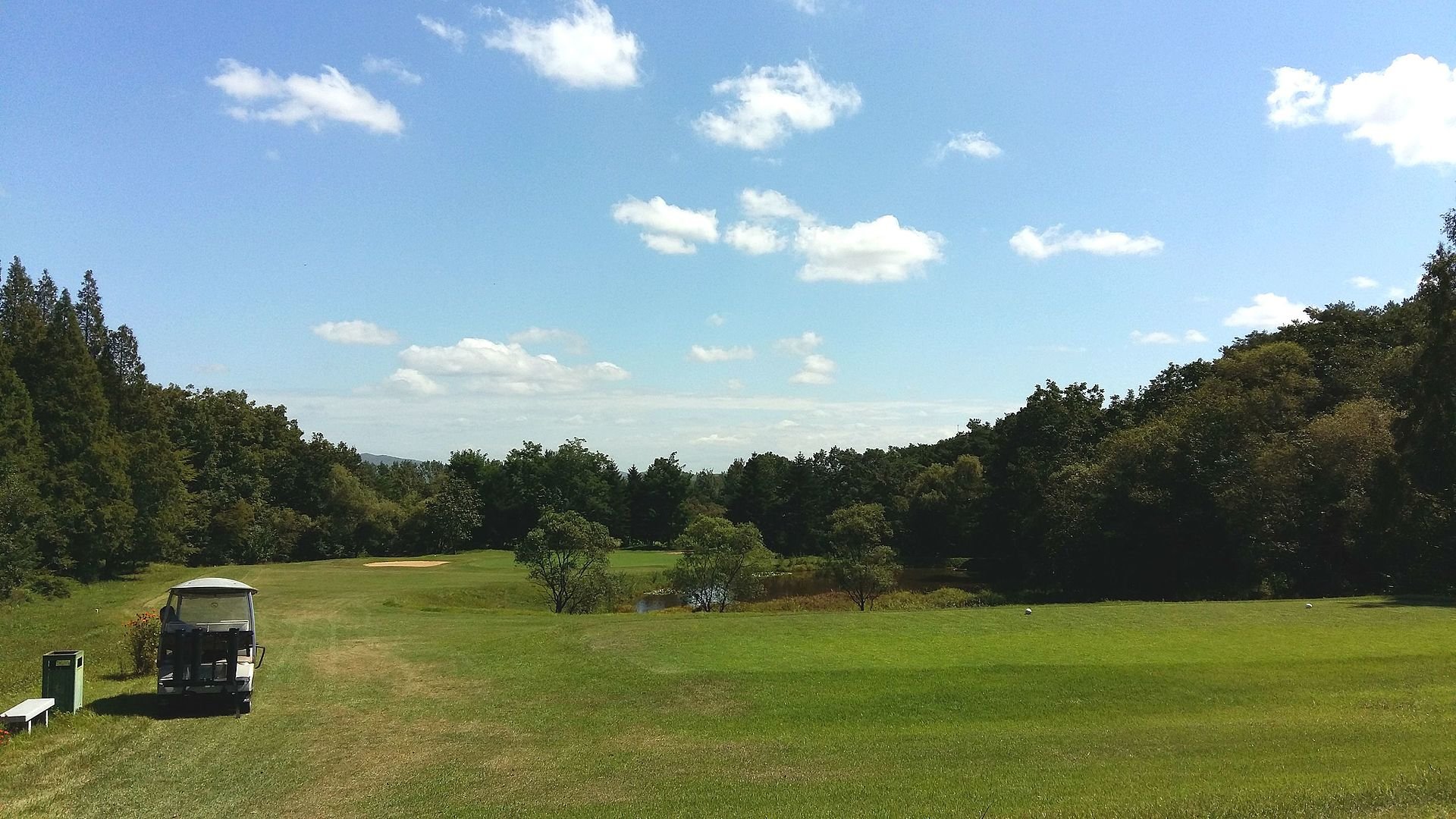
  • Weeks later, it was reported that North Korea began to demolish a $75 million South Korean-owned golf resort near Mount Kumgang without permission from the company Anati that built the facility. The Ananti Golf and Spa Resort was open to South Korean tourists in 2008 for one year, before Seoul suspended all tourism to North Korea after a DPRK soldier shot and killed a South Korean national.

  • Anati’s chairman expressed hopes that his resort could still host the 2025 World Amateur Golf Championship, but this does not seem likely to happen as according to Planet Labs satellite imagery, 10 large lodging buildings have already been partially demolished.

Source:
https://apnews.com/article/business-travel-seoul-south-korea-north-korea-bb623f840c86a80a08cd214cad1233b5
https://www.nknews.org/2022/04/north-korea-begins-demolishing-75-million-south-korean-golf-resort-imagery/ 

NORTH KOREANS IN RUSSIA: NO WAY HOME

  • North Korean soldiers dispatched to Russia to earn foreign currency are unable to return home after their three-year services due to Pyongyang’s prolonged border closure as part of their Covid-19 prevention measures.

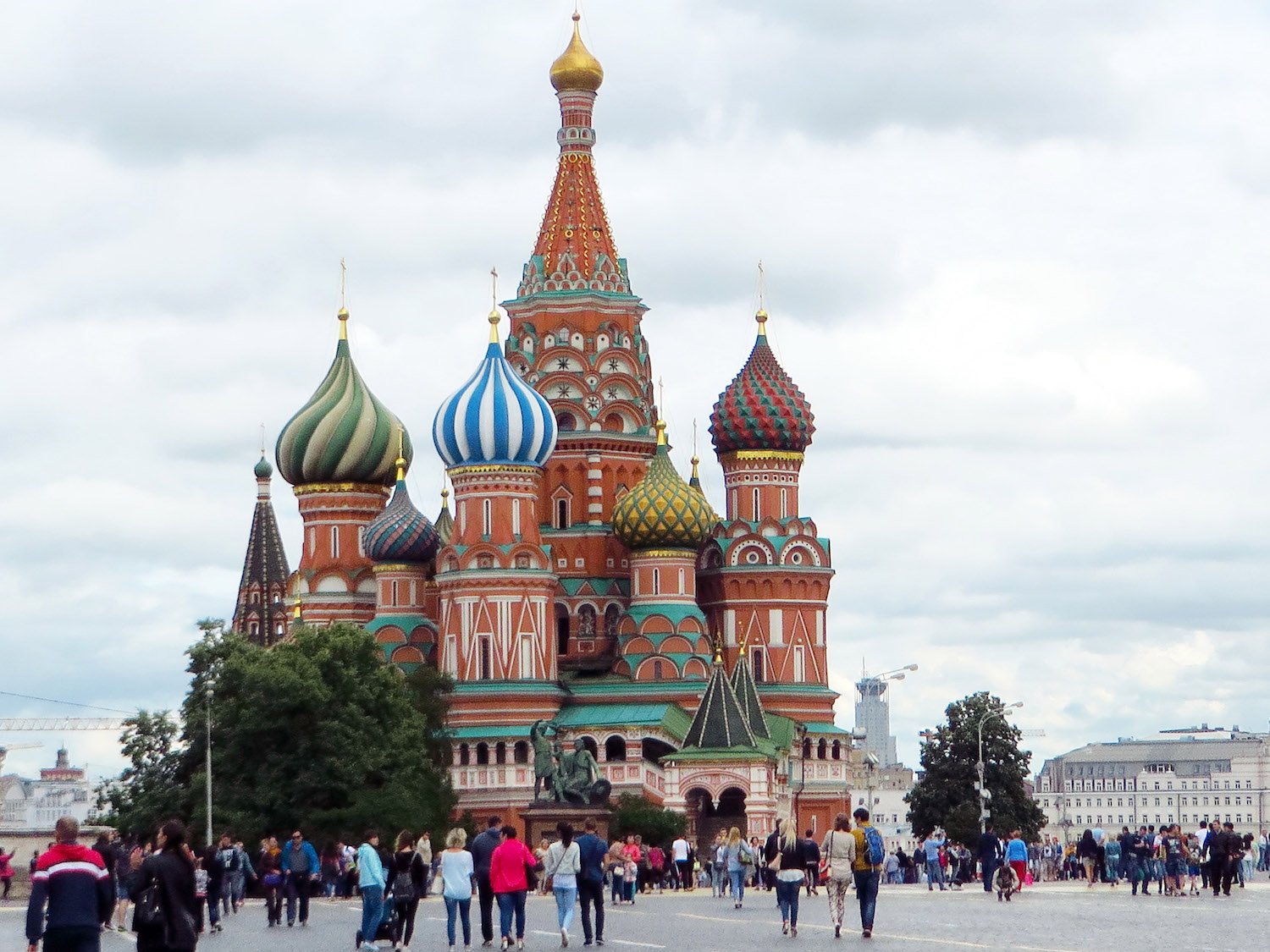
  • According to a North Korean soldier in his 20s, Choi, along with four other soldiers who were sent to Russia in 2018, although they were eligible for discharges from the military in 2021, they were not allowed to return home and are still engaging in foreign currency earning activities in Russia.

  • Choi told Daily NK that two soldiers in similar positions have tried to escape by leaving their base in Moscow without permission in mid-March, but were subsequently apprehended by the Ministry of State Security and imprisoned on charges of attempting to defect.

  • Choi also noted that the “first thing North Korean authorities consider when choosing soldiers to send abroad is whether or not an individual will run away while in a foreign country...[since] soldiers are thoroughly armed politically and ideologically speaking, and because they have families back home [who are used as hostages], [the authorities] prefer them over regular workers.”

  • Despite the heavy emphasis on selecting soldiers who are loyal to the ruling Workers’ Party and Kim Jong-un, Choi explained that “there are many soldiers who are considering escaping due to the long working hours that stretch into the night and poor pay, which is not even enough to buy cigarettes.”

Source:
https://www.dailynk.com/english/north-korean-soldiers-russia-earning-foreign-currency-still-unable-return-home/