North Korean church

A "Fake" Revival with Real Impact: The True Story Behind the Movie Choir of God

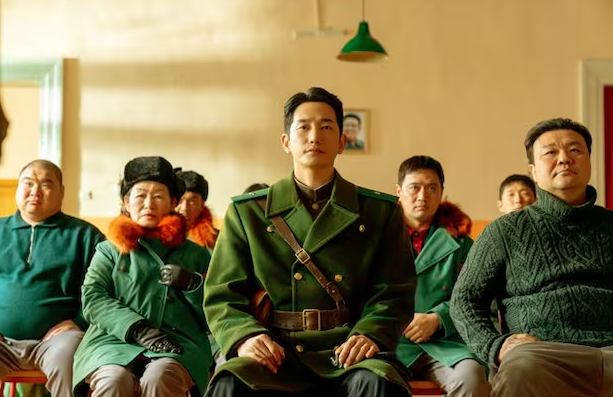
Recently, our staff took our Elim House residents to see the newly released South Korean film Choir of God. What began as a simple community outing quickly became something far more meaningful. Many of our residents left the theater visibly moved, and the conversations that followed – about faith, worship and the reality of believers in North Korea – made lasting impressions on the group, who immediately recognized their own journeys reflected in the film’s themes.

Based on a true story, Choir of God has emerged as a surprise hit in South Korea, drawing attention not only for its artistic originality but for its bold portrayal of Christianity under repression in North Korea. For our community, the film resonated deeply during our subsequent worship service, where Kelly, inspired by the film, offered a special praise that captured the spirit of gratitude and solidarity it stirred in all of us (read more on Kelly’s story).

WHAT THE FILM SAYS ABOUT FAITH IN NORTH KOREA

The premise of Choir of God feels stranger than fiction. The film follows a state-approved choir in North Korea, created by the regime to showcase religious tolerance and win international acceptance while under ongoing sanctions. As the singers developed genuine faith, authorities ordered their execution, but the surveillance officers risked everything to help them escape to China, transforming a propaganda scheme into a story of courage and conscience. Notably, the choir performed internationally recognized Christian worship songs such as “Way Maker” and “Grace,” carefully staged to project harmony and openness, while genuine Christian faith remains brutally suppressed behind the scenes. 

What makes the film especially compelling is its unexpected tone. Rather than presenting a grim narrative, Choir of God weaves in moments of dry humor and human warmth. The irony of joyful worship music performed under coercion becomes a powerful metaphor for faith constrained but not extinguished.

However, while Choir of God effectively portrays the severe repression faced by Christians in North Korea, some defectors say the film takes dramatic liberties. One scene depicts a security officer whose mother was executed for underground church activity – an outcome that former diplomat, Kim Chol-sing, noted as “fictional and unrealistic” since such a child “would be sent to an orphanage immediately” and barred from state service. Jang Guk-cheol, a defector, added that even descendants of politically controversial families were prohibited from joining the ruling Workers’ Party. Other scenes portraying security officials as unfamiliar with South Korean music were also questioned. Kim Chol-sing pointed out that “The state security ministry is not stupid,” while another defector, Jang Se-yul, commented that monitoring foreign media is central to their job.

Despite these criticisms, many defectors agree the film accurately reflects the reality that genuine Christian faith survives only underground. Choir of God draws inspiration from a “fake revival” held at Pyongyang’s state-approved Chilgol Church in 1994, which the movie’s director, Kim Hyung-hyup, said was staged during the regime’s outreach to American evangelist, Billy Graham. By way of background, Chilgol Church is a real institution that is said to sustain the illusion of religious freedom. As Jang Se-yul described, “My aunt used to go to the church to promote the idea to foreigners that we now have freedom of religion … In reality, she was just a fake congregant.” These accounts align with broader findings. The U.S. State Department has confirmed the DPRK’s denial of religious freedom as “absolute,” and a 2025 Database Center for North Korean Human Rights report found that nearly all defectors say free religious activity is impossible, with many reporting punishments by political prison camps.

But the struggle for religious freedom isn't confined to the silver screen or the North Korean border. Today, our brothers and sisters in China are facing a parallel storm.

CHRISTIANS IN CHINA LIVING IN FEAR

While Choir of God is set in North Korea, its message feels painfully current when viewed alongside developments in China. The film’s exploration of how faith survives under authoritarian pressure mirrors what Christians in China, including our staff and defectors under our care, are experiencing right now.

Gao Ying-jia, a senior pastor in one of China’s largest underground house church networks, was arrested after plain-clothed police knocked on his door at 2 a.m. while he and his wife were hiding with friends in a Beijing suburb. Their young son slept upstairs as they went down quietly, knowing, as his wife later said, “our time was up.” Two months later, Gao remained in detention, charged with “illegal use of information networks,” part of what human rights groups describe as the most sweeping crackdown on Christians since 2018. “We both knew that as Christians in China, there were risks,” his wife, Geng Peng-peng, said after fleeing overseas with their child, “But to be honest, you can never be fully prepared.” Since Gao’s and dozens of other pastors’ arrests, raids expanded nationwide. In one eastern city alone, more than 100 Christians were reportedly detained in a single week. Now Geng faces impossible choices about where to live and how to protect her family, “Sometimes I wonder, is this real?” 

Over the past year, Chinese authorities have intensified efforts to dismantle underground and house churches. Pastors and church members have been arrested or detained, private homes used for worship sealed and congregations forced to disband as part of a nationwide campaign to assert state control over religion. With increased surveillance, mandatory registration requirements and coordinated police raids, many believers are driven to abandon communal worship altogether as China’s regulations on religion increasingly frame independent Christian gatherings as threats to national security.

Seen through this lens, Choir of God is more than a cinematic surprise hit. For our defector community at Elim House, it was a rare moment of being 'seen.' For the rest of us, it is a sobering invitation to remember—and pray for—those who still find the courage to worship in the shadows.

Once Upon A Time, North Korea was the Christian Hub of the East - Part 2

Surrender in a village during The Korean War.

PYONGYANG SEMINARY BIRTHED CHURCH LEADERS

When the first seven graduates finished their studies at the Pyongyang Theological Seminary in 1907, the mission boards of the Southern Presbyterian Church (US), the Northern Presbyterian Church (US), the Canadian Presbyterian Church, and the Australian Presbyterian Church, agreed to establish the first presbytery in Korea. This is an important event which solidified Pyongyang’s importance in the history of Korean Christianity as until this time, most missionaries and leaders in Korea were overseen by the denominations and mission boards of the Western missionaries.  

Soon after, the General Assembly of the Presbyterian Church of Korea was established in 1912, where Horace Underwood and Kil Sun-ju were elected as its first moderator and vice-moderator, respectively, during a meeting at the seminary in Pyongyang. Other denominations were subsequently formed to build and support the growing church community in Korea.

WHY DID NORTH KOREAN CHURCHES DISAPPEAR?

The prevailing perspective that has long dominated the South Korean and western view of North Korea is that, since the division of the two the Koreas, North Korean Christianity practically vanished except for a very limited number of “underground” Christians, since most Christians, especially leaders, had to flee to the South for religious freedom following a series of persecutions by the regime.  

Shedding new light on the matter, Japanese historian, Sawa Masahiko, studied two of the multi-volume 1960s collections of Kim Il-sung’s addresses and writings and found that, unlike Marx and Lenin, Kim seldom attacked religion or Christianity per se, but rather focused his criticism on such political allegations that Christianity came to Korea as the forerunner of imperialism, and that some “bad” Christian leaders opposed the nationalist nation-building in North Korea and collaborated with the Americans during the Korean War. Sawa also questioned if the reason why there was no church in North Korea was because of North Korean communism as such, but rather with the nature of Korean Christianity itself, making it unable to exist in a socialist environment.

Alternatively, Korean scholar, Dae Young Ryu, proposed a new perspective to understand the history of North Korean Christianity as a history of North Korean Christians’ constructive efforts to survive, adjust, and change in the midst of a hostile environment. Ryu noted that, during the Japanese occupation, North Korean Christianity mainly became the religion of businessmen, professionals, and landlords. Even though a vast majority of the North Korean population was poor tenant farmers, few of them embraced Christianity. When the nationalist-socialist government came into power after the liberation, established Christians became antagonists of the nationalist-Marxist revolution and fled to the South, while lay people simply accepted socialism as a reality. Further, U.S. air raids that caused immense human suffering to North Koreans during the Korean War planted a burning hatred of Americans within the nation. Thus Christianity, which was seen as an American religion, became an object of contempt and ridicule. As a result, many North Korean Christians lost their faith as they rebuilt the war-stricken nation.

Once Upon A Time, North Korea was the Christian Hub of the East - Part 1

Prayer meeting in Pyongyang in 1908.

Nowadays, the history of Christianity in North Korea is often perceived as one of persecution. This is especially so given the current regime under the Kim Dynasty considers “all religions [a] social evil” and persecutes Christians more severely than any other religious believers as they are regarded as “agents of Western imperialism.” North Koreans accused of practicing Christianity are detained incommunicado in political prison camps called “kwanliso,” where detainees are imprisoned indefinitely, and forced to endure inhumane treatment including torture, starvation, rape, and forced abortions. North Korean authorities also detain three generations of the accused’s family to further deter ideology it deems unacceptable.

It is therefore puzzling to imagine that only a century ago and before Korea was divided into two, Pyongyang was considered “the Jerusalem of the East,” a model of success for missions and the center of a growing Christianity in Korea.

CHRISTIAN SCHOOLS IN PYONGYANG

Pyongyang was the site of a number of Christian schools, including Pyongyang Theological Seminary (also known as the Pyongyang Theological Academy), the first graduate institution that trained pastors in Korea and became the centre of Korean Christianity in the early 20th century. The seminary was founded in 1901 by Samuel Austin Moffett, a Presbyterian missionary, who was motivated to establish the seminary in Pyongyang after the city had been badly damaged in the First Sino-Japanese War. Moffett headed the school as president until 1918 and served as a faculty member until 1935. By 1905, there were over 40 students engaged in a five-year curriculum, which included three months of classroom instruction and nine months of practical ministry engagement in local churches.

The Pyongyang-based seminary was temporarily closed under pressure during the Japanese occupation of Korea in 1938. Japan instituted a mandatory Shinto shrine-worship order, which precipitated a crisis for Christianity in Korea that resulted in the closing of hundreds of mission schools and the withdrawal from the country of many foreign representatives of Christian organizations. Nonetheless, the seminary marks significant importance in the history of Korean Christianity as numerous Presbyterian and reformed seminaries in South Korea see themselves as its heirs.

REBIRTH AND REVIVAL OF CHRISTIANITY

North Korea is also the location of the Great Pyongyang Revival of 1907, which was a Protestant revival that occurred in and around the city of Pyongyang. After the first Western missionaries arrived in Korea in 1885, the church community grew rapidly and reached over 200,000 followers by 1910. Interestingly, most of these believers were from what is now a part of North Korea. The Pyongyang Revival began at Jangdaehyeon Church, when hundreds of men and women gathered to attend the annual Bible conference for revival and repentance under the leadership of the church pastor, Kil Sun-ju, who incidentally was one of the first graduates of the Pyongyang Theological Seminary. The revival’s aim was to redirect its followers to focus on spiritual matters in the midst of political and national crisis in Korea. 

Presbyterian missionary, William Blair, also preached to thousands of Korean men during the national repentance movement to encourage them to turn away from their traditional hatred of the Japanese, with whom Korea had a long history of conflict. One missionary described the meeting as “the sound of many praying at once…a  vast harmony of sound and spirit…[where God] came to us in Pyongyang that night with the sound of weeping.  As the prayer continued, a spirit of heaviness and sorrow for sin came down upon the audience…Man after man would rise, confess his sins, break down and weep, and then throw himself to the floor and beat the floor with his fists in perfect agony of conviction…we would all weep, we could not help it. And so the meeting went on until two o’clock a.m., with confession and weeping and praying.”  

Stay tuned for the final part of our series, “Once Upon A Time, North Korea was the Christian Hub of the East.”