
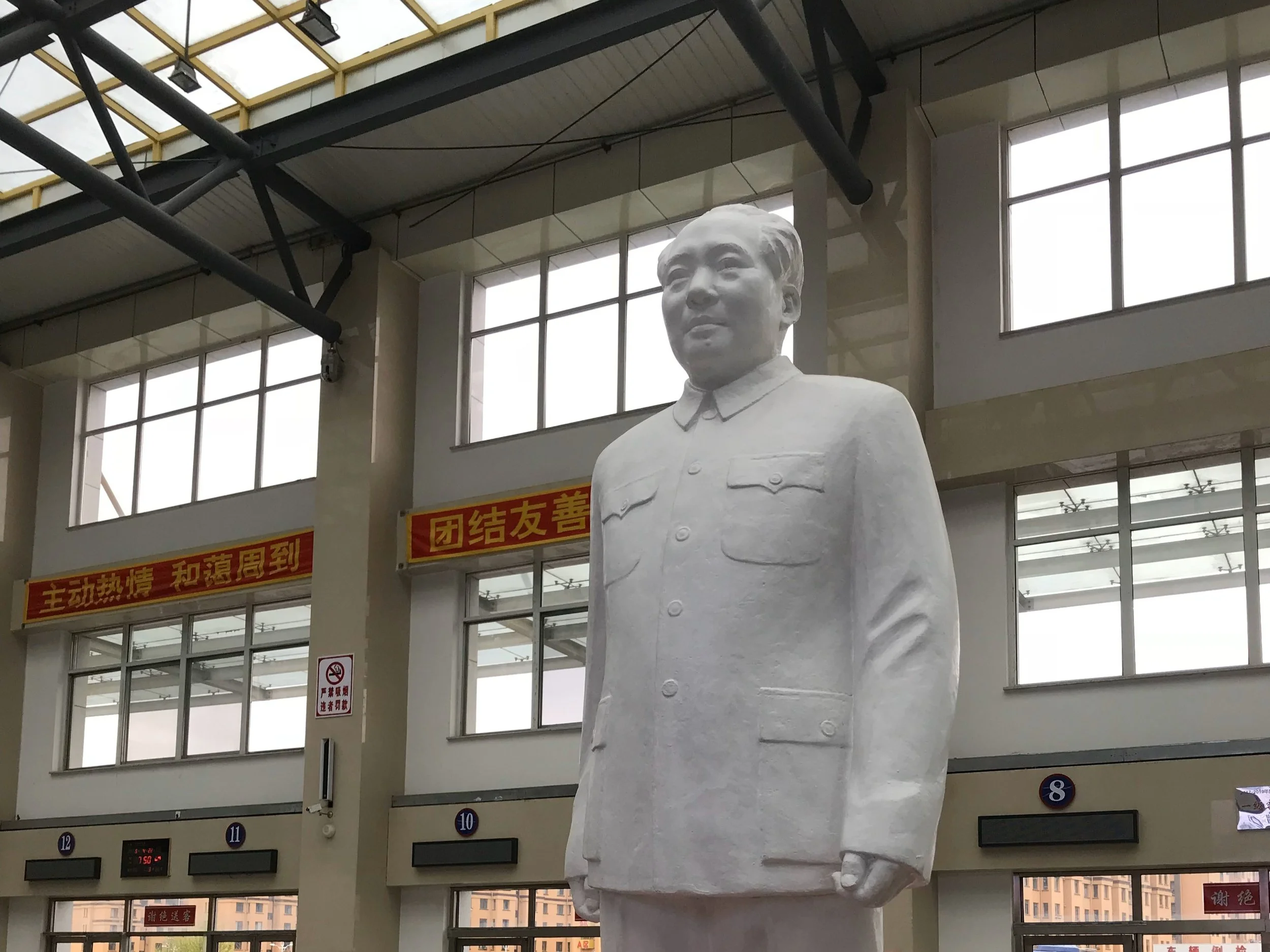
A statue of Mao Zedong in a tour bus station in China
Following Chinese President Xi Jin-ping’s recent visit to Pyongyang, optimism has surged among Chinese travel agencies hoping for a revival of cross-border tourism. With July marking the traditional peak summer travel season, tour operators are blitzing social media with promotional packages. Yet, beneath the surface of this state-encouraged diplomatic warmth, Chinese tourists are overwhelmingly saying “no thanks” to North Korea.
THE 8,000 YUAN QUESTION
For years, Chinese travelers made up most of North Korea’s foreign visitors, providing a crucial lifeline of hard currency to the heavily sanctioned regime (read more on Is It Ethical to Travel to North Korea). Hoping to revive that pipeline, agencies in China’s Beijing, Nanjing and Shenyang have been aggressively marketing July departures. The itineraries circulating online propose a seven-night journey via the international train from the Chinese border city of Dandong to Pyongyang. The tours promise stops at iconic state monuments like the Juche Tower, the Arch of Triumph, the Mansudae Art Studio and the border village of Panmungak.
However, these packages come with a steep price tag: approximately 8,000 Chinese yuan (around $1,100 USD). In China’s current economic climate, consumers are becoming intensely value-conscious. Across online platforms like China’s Google, Baidu, commenters have been quick to point out that even spending 5,800 yuan is an exorbitant amount for a destination that many increasingly view as outdated and unappealing. For the same price, they could enjoy a relatively luxurious, unrestricted holiday in South Asia. One recent visitor who spent five days in North Korea noted the absurd inflation for foreigners: “A single watermelon costs 160 RMB (approximately $24 USD). Whatever you do, it feels like you are spending dozens of times the normal price.” Another traveler from Hangzhou, the birthplace and headquarters of tech giant Alibaba Group, who spent six days between Pyongyang and Sinuiju, echoed this sentiment. Confined to the Yanggakdo Hotel on an “isolated island” where tourists cannot leave the gates without a guide, he observed that even basic modern necessities are priced as extreme luxuries in North Korea: “There is virtually no entertainment, and internet is shockingly expensive – $150 USD for 1GB of data … and the connection is unbearably slow. If you factor in the tour fee and personal expenses, you are burning through thousands of yuan a day just to be able to do anything.”
A SCRIPTED REALITY
Beyond the financial cost, the actual travel experience is far from a relaxing getaway. One recent tourist even described the train journey from Dandong as a “survival challenge,” as the trains are “dilapidated and freezing, transporting visitors back decades into history.” Upon arrival in Pyongyang, the atmosphere left an equally haunting impression, with a tourist detailing his experience as one filled with extreme contradictions: “My impression of Pyongyang is a city that is both glamorous and run-down, high-profile yet deadly silent, characterized by extreme order and extreme emptiness. … It is so quiet that there is not even a single clothes drying rack in sight, smartphones have no signal and female traffic police simply turn their backs to you. Yet it is also incredibly glamorous – huge crowds march in perfect unison, towering 70-story buildings, spotless model streets without a speck of rubbish and tour guides who are always smiling.”
Other visitors shared similar experiences, describing the streets as exuding a “silent pressure,” and likening Pyongyang to “a city where no one speaks.” Meanwhile, this eerie silence is frequently juxtaposed with “incredibly loud” state propaganda. A tourist noted, “imagine dozens of giant loudspeakers buzzing simultaneously over your head without stopping. They hand out prizes, pots and soap on the street, telling you it is a blessing from the state.” To many, this “scripted city” feels more like a movie set than a living capital, especially when the day abruptly ends at 11 p.m., when Pyongyang cuts its power and the façade falls away, leaving tourists in the dark. For those who visit, this abrupt darkness serves as a brief, jarring glimpse into the profound daily hardships and realities endured by the people who live there.
THE DEMAND FOR FREEDOM
Among other criticisms, Chinese netizens are voicing a common, though highly ironic complaint: North Korea simply does not offer enough personal freedom. Travel to the DPRK has always required strict adherence to state-approved itineraries. Wandering away from the group, interacting with locals, taking unauthorized photographs or speaking freely about politics are strictly forbidden: “All you can do is obediently join a tour group, follow the crowd step-by-step and avoid doing anything that might upset the guide.” In the past, perhaps many Chinese tourists viewed this as a nostalgic novelty, like a trip back in time to an era resembling China’s own mid-century past, but today, the novelty has worn off. Modern Chinese travelers, accustomed to the autonomy of independent global travel, are increasingly chafing at the restrictions, with one visitor complaining that “you are stared at the entire time. … Communication has zero privacy … you just listen to orders. When reminded of the strict system in place, you are expected to simply remain silent.”
Interestingly, discussions criticizing North Korea’s lack of freedom of speech and movement are circulating widely on major Chinese platforms without obvious signs of state censorship. The fact that Beijing’s sophisticated censorship apparatus is allowing these critical discussions to remain live suggests that Chinese authorities may be perfectly comfortable letting grassroots sentiment dictate the pace of economic engagement with Pyongyang, regardless of the recent summit’s optics.
“ “After reading this, [we should] appreciate even more when we can travel freely.””
Perhaps the most remarkable encapsulation of this shifting dynamic came from an unexpected source. Underneath a recent social media post detailing the restrictive realities of touring North Korea, an official account belonging to the Chongqing China Youth Travel Service left a comment that quickly caught attention: “After reading this, [we should] appreciate even more when we can travel freely.” The tone is indeed striking, especially coming from a state-owned and state-controlled enterprise that is deeply embedded in the government’s tourism sector. By publicly and implicitly contrasting the travel freedoms enjoyed by Chinese citizens elsewhere with the constraints of their neighbor, it becomes clear that this year’s marketing push faces an uphill battle.
As summer peaks and the travel agencies wait for an official resumption of tourist visa issuance that has yet to fully materialize, the message from the Chinese public is loud and clear. Diplomatic ties might open the door, but it will take much more than expensive, standardized itineraries to convince them to walk through it. More importantly, as we reflect on these highly controlled tours, our hearts remain with the people of North Korea, maintaining a quiet hope for a day when true freedom, peace, and lasting restoration can reach them.